Test 1 Hello
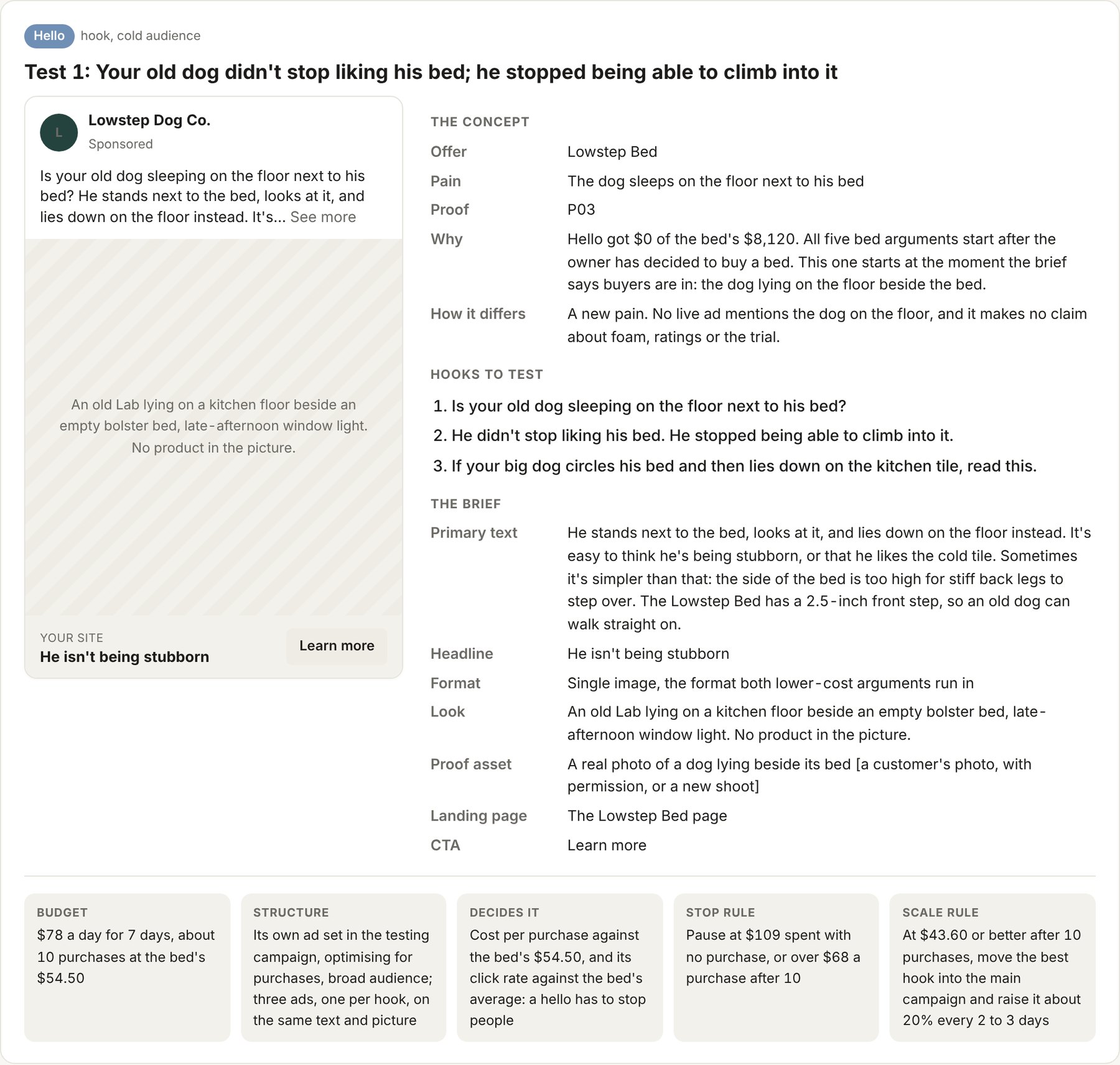
"Is your old dog sleeping on the floor next to his bed?"
Names the moment the owner is already living in. No product claim until the last line.
Fills the empty job. $0 of the bed's $8,120 went to stopping a stranger.
For anyone who's had enough ad advice
None of them match, because they're talking about ads in general. Your question is about the ads in your account. The Ad Strategy Machine reads the ones you paid for in the last 30 days, counts the different arguments they make, shows what each one cost per sale, and plans the three tests your account is missing.
Lowstep Dog Co. is a demo store. Its ad account is invented; the sort is what the Machine made of it.
One run, on one dog-bed store's ad account
You know this one
New hooks. New images. A founder video. A batch from the designer, and another from the AI tool everyone's using.
The account looks busy. The results look the same. And most of the money still ends up behind one ad, like it did last month.
So you go looking for what "diversify your creative" is supposed to mean.
Everyone has an answer. None of them match.
Test the hook. No, test the format. Test everything. No, test one thing. And every person saying it swears it worked for them.
Nobody can tell you whether your ads are different, because nobody has read them.
The advice is about ads in general. Your question is about the thirty in your account, and it has an answer you can count.
Here's the part that gets skipped
An ad is an argument: a reason to buy, and a reason to believe it. Put the same argument under six pictures and you have one ad wearing six hats.
Two ads are different when they differ in at least one of three things.
The problem the reader recognises. "My dog's bed went flat" and "my dog sleeps on the floor next to his bed" are different pains.
Why your answer works. "Foam that keeps its height" and "a front step low enough to walk onto" are different mechanisms.
Why they should believe you. A lab test and a customer's own words are different proof, even for the same claim.
A viewer put it this way under one Andromeda explainer: three videos with the same script and the same images "aren't three ads to Andromeda, they're one."



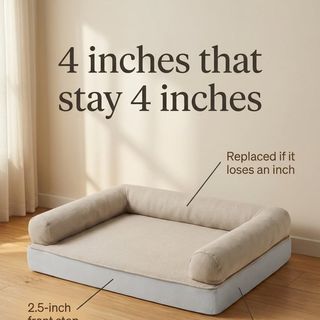


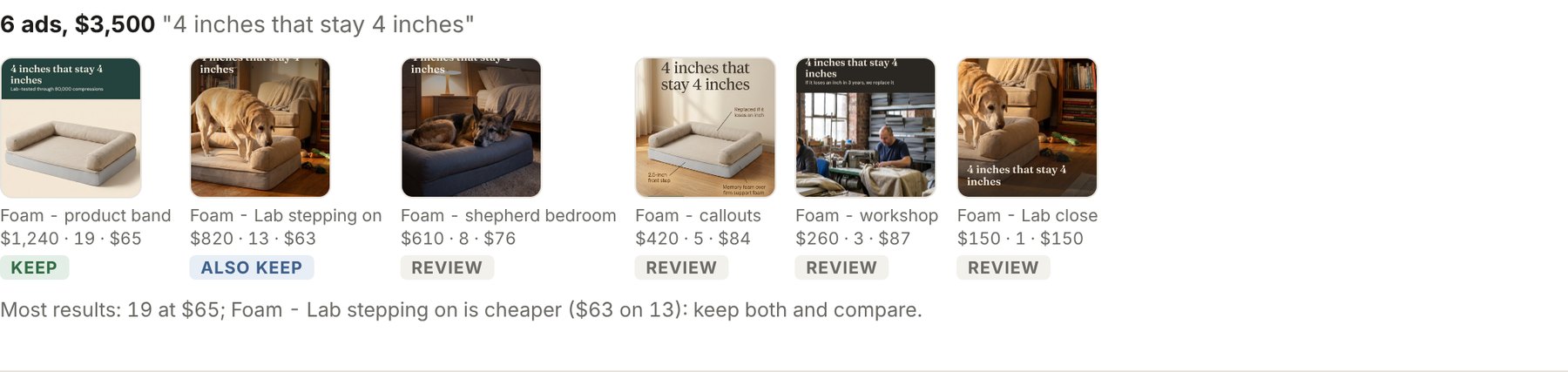
Six of the demo store's ads. Same primary text, same headline, $3,500 between them in 30 days.
Straight talk: nobody outside Meta can tell you exactly how its system groups your ads, and Meta publishes no number of ads to run. What you can check is your own account: what each ad argues, what it cost, and what it sold.
So why hasn't anyone counted?
You may have seen the 30-second version: open Ads Manager, sort by amount spent, count the ads. That tells you how many ads got money. It can't tell you how many arguments you're running, what each one costs you per sale, or what to make next.
The Ad Strategy Machine
It installs into Claude and works like a small strategy desk. There are no prompts to write and no keys to paste. You connect Meta's own ads connector by signing in with Facebook, say "Run Ad Strategy", and read the verdict. It only reads your account. It never changes a budget, an ad or a setting.
Every ad that spent money in the last 30 days, by spend, with its text, headline, picture, offer and results. Not only the ones marked active.
Same words in a new picture count once. Each argument gets its spend, its sales, its cost per sale against its own offer, and the job it does for a buyer.
Three new arguments, missing jobs first. Each is a brief you can hand to an editor: three hooks, the text, the headline, the look, a budget and a stop rule.
A run on the Lowstep demo account, shortened. The dark bubbles are everything the owner types.
Run Ad Strategy
Meta's connector is on, and I can see one ad account: Lowstep Dog Co. I'll read the ads that spent money in the last 30 days. I won't change anything in the account.
Go ahead?
Yes, go.
Reading the 30 ads that spent money
Sorting them by the argument they make
Scoring each argument against its own offer
Done. You're paying for 30 ads. They make 7 different arguments.
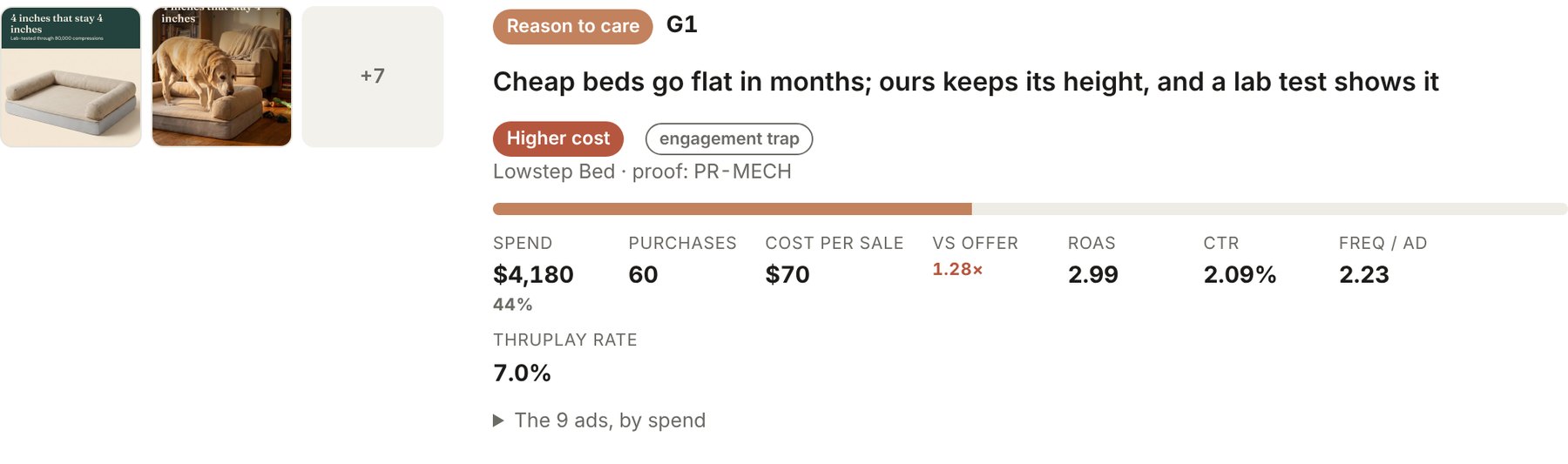
"The foam keeps its height" is 9 of them and 44% of the spend, at $70 a sale against the bed's $54.50.
Your two lowest-cost arguments, owners' reviews and the 100-night trial, got 16%.
6 ads are the same words in 6 pictures.
Nothing stops a stranger: $0 on hello.
Shall I plan the three tests?
Yes. What's missing?
1. A hello: "Is your old dog sleeping on the floor next to his bed?"
2. The low front step. It's the one thing only you can say, and none of the 30 ads argues it.
3. A review card for the worry about accidents.
One thing before you launch: test 3 quotes Amy's review. Confirm she's agreed to it being used in ads.
Opening your report now.
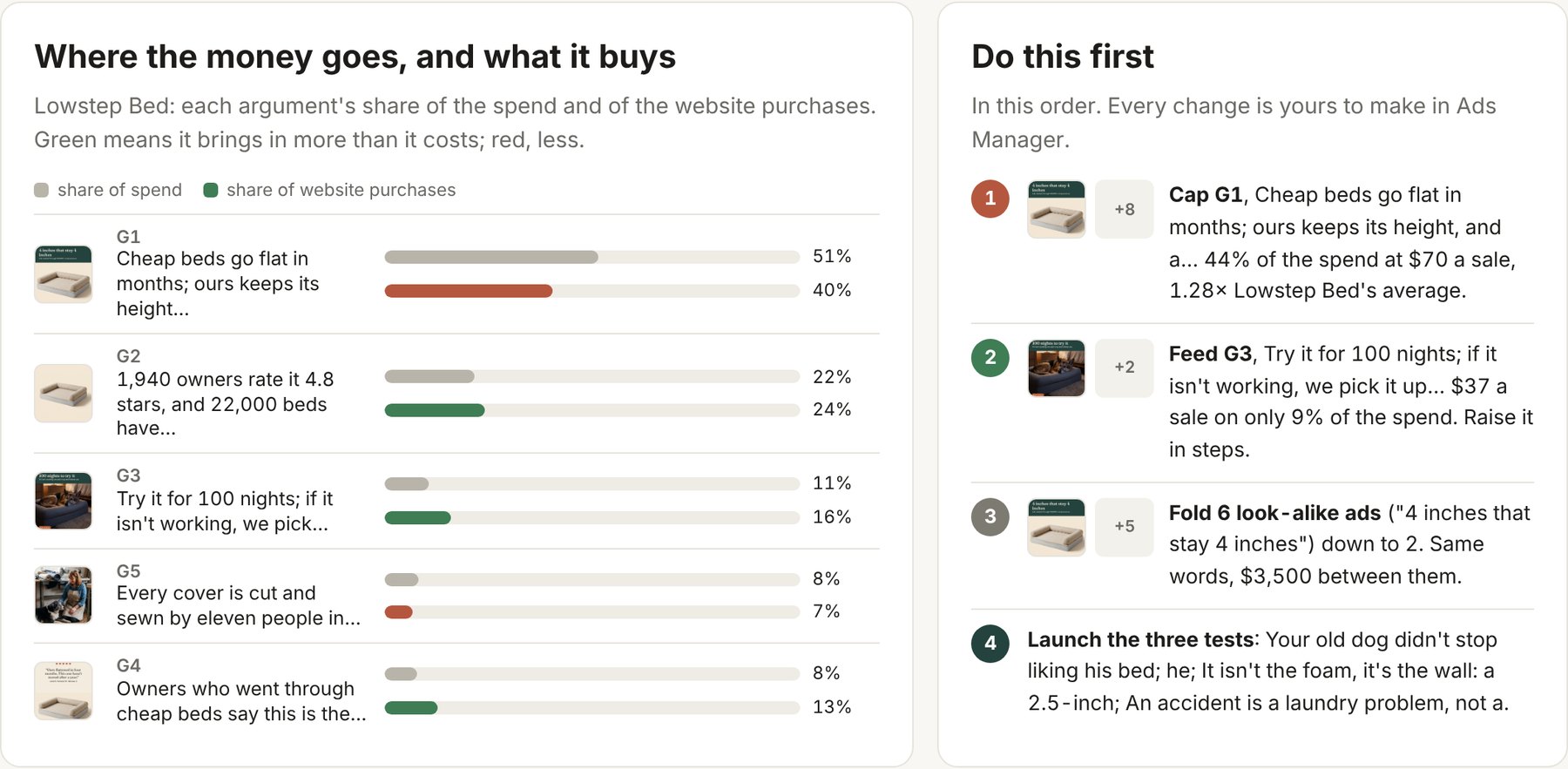 Your report · where the money goes, and what it buys
An illustration based on the Lowstep run, with the wording shortened. On a first run the Machine also asks a few questions about what you sell and who buys.
What comes back
Lowstep Dog Co. is the demo store we built to show the Machines working. It sells orthopedic beds for senior dogs, with a low front step so a stiff old dog can walk straight on. We gave it an ad account: 30 ads, $9,400 and 189 sales over 30 days. Those numbers are invented. The report below is what the Machine made of them.
The store's 30 ads, sorted by what they argue




















| Argument | Ads | Spend | Sales | Cost per sale | Against its offer | Verdict |
|---|---|---|---|---|---|---|
| The foam keeps its heightReason to care | 9 | $4,180 44% | 60 | $70 | 1.28× | Higher costMore clicks than average, costlier sales |
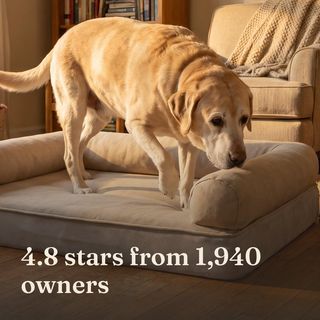
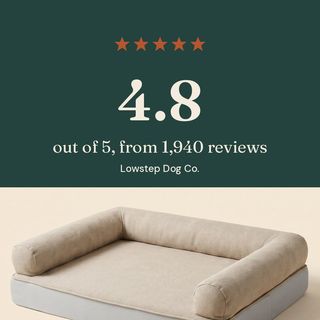
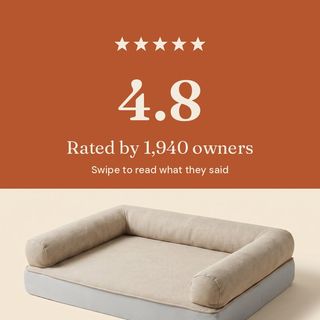
| 4.8 stars from 1,940 ownersProof | 6 | $1,750 19% | 36 | $49 | 0.89× | On parSigns of fatigue |
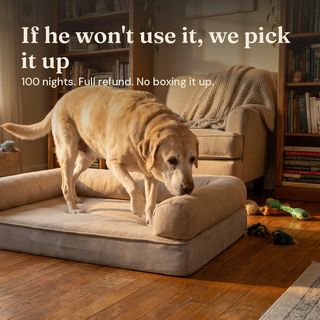
| 100 nights to try itClose | 3 | $880 9% | 24 | $37 | 0.67× | Lower costOnly 9% of the spend |
| Bed and ramp bundle, save $39Close | 3 | $760 8% | 9 | $84 | – | Too earlyUnder 10 sales: not judged |
| Made by eleven people in ColumbusReason to care | 3 | $670 7% | 10 | $67 | 1.23× | On par |
| Owners say it's the first one that lastedProof | 3 | $640 7% | 19 | $34 | 0.62× | Lower costOnly 7% of the spend |
| Grip socks for hardwoodReason to care | 3 | $520 6% | 31 | $17 | 1.00× | On par |
Each argument is judged against the average cost per sale of the offer it sells, never across offers. The bed's average was $54.50. Under 10 sales is too early to call.
The biggest share of the budget sat behind the bed's costliest argument. "The foam keeps its height" took 44% of the budget and cost $69.67 a sale. Owners' reviews cost $33.68 and the 100-night trial $36.67, and together they got 16%.
The Machine doesn't call that a verdict on the foam. Those ads got more clicks than the bed's average and still cost more per sale, so its first instruction is to read the landing page before cutting the hook.
A stranger needs four things before buying: something that stops them, a reason to care, proof, and a close. Each argument does one of them. The Machine shows where the bed's $8,120 went.
Not one of the 24 bed ads was built to stop someone who isn't shopping for a dog bed yet.
Test 1 Hello
Names the moment the owner is already living in. No product claim until the last line.
Fills the empty job. $0 of the bed's $8,120 went to stopping a stranger.
Test 2 Reason to care
The 2.5-inch front step: the one thing only this store can say.
None of the 30 ads argued it. 60% of the bed's spend sat on reason-to-care ads, almost all of it on foam.
Test 3 Proof
A customer's line about accidents, the waterproof liner and the washable cover.
Answers a doubt no ad touched, in the form of the account's lowest-cost argument: a customer's own words.
These are tests, not winners. Each one comes with a stop rule for a reason.
The part most AI tools get wrong
Ask a chatbot to "analyse my ads" and it will find a winner in whatever you paste. The Machine has rules about what the numbers are allowed to say.
Ten or more sales is reliable. Three to nine is a direction, and it says so. Fewer isn't judged. In the Lowstep run, the bundle had 9 sales, so the Machine left it alone.
A $22 pack of socks and a $199 bed are never compared. Every argument is scored against the average cost per sale of the offer it sells.
The briefs use only facts in your proof bank. The founder's story wasn't in Lowstep's, so the Machine put it in brackets to confirm, and asked for a customer's permission before quoting her review.
It won't recommend more of an argument you're already running. The plan is three tests, each different from every live ad and from each other.
What installs
Runs the work and the checks. Asks what you sell and who buys, once, and keeps you out of the machinery.
Reads the ads that spent money, with their text, pictures, offers and results. Reads only: it can't change your account.
Groups ads by argument, finds the same-words copies, scores each argument against its offer, and gives each one its job.
Writes the verdict, the cap, feed and fold list, and the three tests as briefs. Builds the one-page report.
The next run reads the last one: which arguments grew, which shrank, whether the empty job got filled, and whether your three tests went live.
The math
| A creative strategist on staff | About $60,000 to $155,000 a year |
| Counting it by hand | An afternoon per account, every month |
| Another month of the same arguments | Whatever you spend, on what you already know |
| The Ad Strategy Machine | $67, once launch price, $199 after |
Salary range from ZipRecruiter's US creative strategist listings, June 2026.
$67
Once. Yours to keep.
Launch price. It goes to $199 when this promotion closes.
Install the Ad Strategy MachineLearn something about your account, or your money back. Run it on an account with at least 10 ads that spent money. If the report doesn't show you something you can act on, email it to me within 14 days and I'll refund you.
You'll also need a paid Claude plan, and a Meta ad account that has spent money in the last 30 days.
You can, and you should: it takes 30 seconds and tells you how many ads got money. The Machine does the part that takes an afternoon. It reads every ad's words, groups them by argument, puts spend and sales behind each one, finds the jobs nobody is doing, and writes the three briefs.
You'll get an opinion. The Machine works from your account's own numbers and follows fixed rules: same words count once, every argument is scored against its own offer, under 10 sales isn't judged, and nothing is called a winner for spending the most.
No. When Meta returns its own rating for your ad sets, the report shows it. It often isn't available, so the Machine never depends on it. Its own count is by argument: what each ad says and why a reader should believe it.
No. It reads your ads and their results and writes a report. It never changes a budget, an ad or a setting, even if a tool offers to. Every change is yours to make in Ads Manager.
No. Setup is three steps in the Claude app: upload one file, connect Meta's ads connector by signing in with Facebook, and type "Check the Ad Strategy install". There are no API keys and nothing to edit. It takes about 5 minutes.
A paid Claude plan with code execution turned on, and a Meta ad account that has spent money in the last 30 days. It can be your own or one you manage for a client.
Meta is still rolling its connector out, and some accounts aren't reachable yet. Export the last 30 days from Ads Manager, attach the file, and say "Run Ad Strategy from this export". The setup guide lists the columns.
Every ad that spent money in the window, up to the top 50 by spend. If fewer than five ads spent anything, it widens the window to 90 days and tells you.
It scores whatever result your campaigns are optimised for: purchases, leads or something else. If there are no results at all, the report still shows where the money went and which jobs are empty. It just won't say what worked.
It writes the briefs: three hooks, the primary text, the headline, what the picture or video should show, the budget, and the stop and scale rules. It doesn't make images or video.
Nobody can promise that. They're the three arguments your account isn't making, each backed by a fact you gave it. That's why every one comes with a budget, a stop rule and a scale rule.
Yes. One license covers your own business and the client work you do with it, and the report can carry your name or your agency's. You can't resell or hand out the Machine's files.
You do. The Machine runs inside your own Claude account and reads your ads through Meta's connector. Nothing is sent to us.
14 days. Run it on an account with at least 10 ads that spent money. If the report doesn't show you something you can act on, send it to me and you get your money back.

I'm Chad Edwards. I've spent 18 years building online businesses in ecommerce and expert-led markets, and buying the traffic for them. Counting what an account is really arguing was the job nobody had the afternoon for, so I built a desk to do it.
The last 30 days of spend are sitting in your account. They say how many arguments you're really running, what each one costs you, and which job nobody is doing. You can brief another batch on a hunch, or you can read them first. Setup takes about 5 minutes, and the first report comes back the same day.
Install the Ad Strategy Machine · $67P.S. The demo store had 30 ads, and not one of them mentioned the thing the store is named after. That's the kind of thing you only see when somebody reads all of them side by side. For $67, once, it gets read on every account you run.